Flat Pack, Full Panic: How IKEA's Instruction Manuals Became the World's Funniest Accidental Comedy Bit
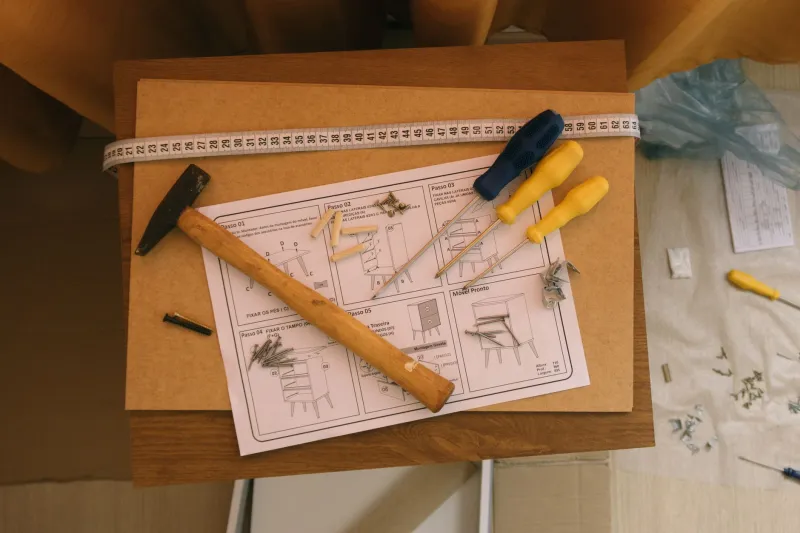
There is a very specific kind of humiliation that only IKEA can deliver. It arrives on a Sunday afternoon, somewhere between Step 7 and Step 8 of assembling what the box promised was a "simple storage solution." You're cross-legged on the floor, surrounded by particle board panels arranged like a crime scene, holding a tiny Allen wrench that feels both inadequate and deeply personal — and you realize you have absolutely no idea what the little bald cartoon man in the diagram is trying to tell you.
Congratulations. You have entered the IKEA Instruction Experience. Population: everyone who has ever owned furniture.
The Man, the Myth, the Minimalist Stick Figure
Let's start with the protagonist of every IKEA manual: that featureless, genderless, vaguely concerned-looking stick figure who appears to be assembling furniture in a completely empty white void. No walls. No carpet. No evidence of a home that actually needs furniture. Just a person and a dream and what appears to be seventeen nearly identical wooden dowels.
This little guy is doing a lot of heavy lifting — emotionally and narratively. He's IKEA's entire communication strategy. No words. No language barriers. Just a bald silhouette radiating quiet optimism in the face of impossible instructions. And somehow, this minimalist mascot has become one of the most universally relatable characters in modern consumer culture. He is all of us. He is suffering in a way that transcends borders.
The genius — and we're using that word very loosely here — is that IKEA made a deliberate choice to strip language entirely from their manuals. The official reason is inclusivity: sell in sixty countries, print one booklet, everybody's confused equally. The unofficial reason, which feels more honest, is that it accidentally created the funniest shared experience in retail history.
Step 3: Insert Dowel Into Ambiguity
Here's where the comedy really lives. IKEA diagrams operate on a confidence that is completely unjustified given the information they actually provide. The illustrations show a dowel being inserted into a hole with such serene clarity — arrow pointing, dotted line indicating depth — and yet, in real life, there are six holes that look identical and the dowel fits into at least four of them. Which one is correct? The diagram has moved on. The diagram does not care about your confusion. The diagram is already on Step 9.
This is the essence of IKEA's accidental comedy: the absolute mismatch between the calm, confident energy of the instructions and the complete psychological unraveling happening in your living room. The booklet communicates certainty. You are experiencing chaos. These two things coexist in a way that is genuinely, profoundly funny — especially in retrospect, and especially when you describe it to someone else who immediately says, "Oh my God, that happened to me too."
That moment of recognition is comedy gold. It's the same mechanism that makes a good stand-up bit land — the sudden relief of someone else naming the exact absurd experience you thought was unique to you.
The Leftover Screw Industrial Complex
No discussion of IKEA instructions is complete without addressing the single greatest mystery in American home furnishing: the extra hardware.
You finish the dresser. It looks right. It's standing upright. You feel proud, maybe even a little smug. And then you look at the floor and there it is — a screw. Just one. Sitting there like a small, silver accusation.
IKEA claims these are "spare parts." Furniture assembly veterans have a different theory, which involves the word "cursed." The internet, naturally, has spent decades generating memes, Reddit threads, and Twitter spirals about this single phenomenon. Because the leftover screw is a perfect comedic setup: you followed every step, you did everything right, and the universe still left you with evidence that something, somewhere, went wrong.
It's Chekhov's Screw. If it appears in the first act, something is going to be structurally unstable by the third.
Why Shared Suffering Is the Best Punchline
What IKEA has accidentally engineered — and what brands with actual comedy budgets should be studying obsessively — is a product experience that creates automatic community. The frustration is so specific, so universal, and so perfectly absurd that it generates content on its own. People don't just complain about IKEA instructions; they perform their complaints. They reenact the confusion. They photograph the leftover hardware. They make their partners witness the exact moment the Allen wrench slips and knuckles meet particleboard.
This is the anatomy of shareable comedy: a relatable premise, an escalating absurdity, and a punchline that feels inevitable in hindsight. IKEA didn't write a joke. They designed a product experience that is a joke, whether they meant to or not.
Some of the most beloved comedy bits in American culture work the same way — they're not about exotic situations, they're about the mundane things that go subtly, persistently, hilariously wrong. IKEA instructions are basically a recurring sketch that millions of people perform live, in their own homes, with real furniture as props.
The Accidental Masterclass Nobody Is Learning From
Here's the thing brands keep missing: IKEA's instruction manuals are not good instructions. They are, objectively, a communication failure dressed up in clean Scandinavian design. But that failure has generated more organic word-of-mouth, more social content, and more genuine emotional bonding than most intentional marketing campaigns ever dream of achieving.
When your product creates a shared language — even a language of bewilderment — you've done something remarkable. The IKEA instruction manual has its own cultural vocabulary: the Allen wrench, the leftover screw, the "which side is the front" crisis, the moment you realize you've attached Panel B before Panel A and now everything must be dismantled and started over. These are comedic touchstones. Everybody knows them. Everybody has a story.
That's not a design flaw. That's an accidental franchise.
The Furniture Is Fine. The Journey Was the Point.
In the end, you get a bookshelf. Or a bed frame. Or whatever the flat pack promised. It stands. It holds things. The leftover screw goes in a junk drawer where it will live forever, occasionally rolling around to remind you that some questions don't have answers.
And somewhere, another person is on their floor, staring at the same little bald stick figure, whispering "what does this even mean" at a diagram that cannot hear them and would not care if it could.
That person is your people. IKEA made you family through the sacred bond of shared, furniture-adjacent suffering — and honestly, that's a more effective community-building strategy than most brands manage with an entire marketing department and a decent budget.
The instructions are chaos. The comedy is free. The Allen wrench is somewhere under the couch.
Welcome to IKEA. You'll figure it out eventually.