Period. Full Stop. You're Dead to Me: The Terrifying Secret Language of Texting Punctuation
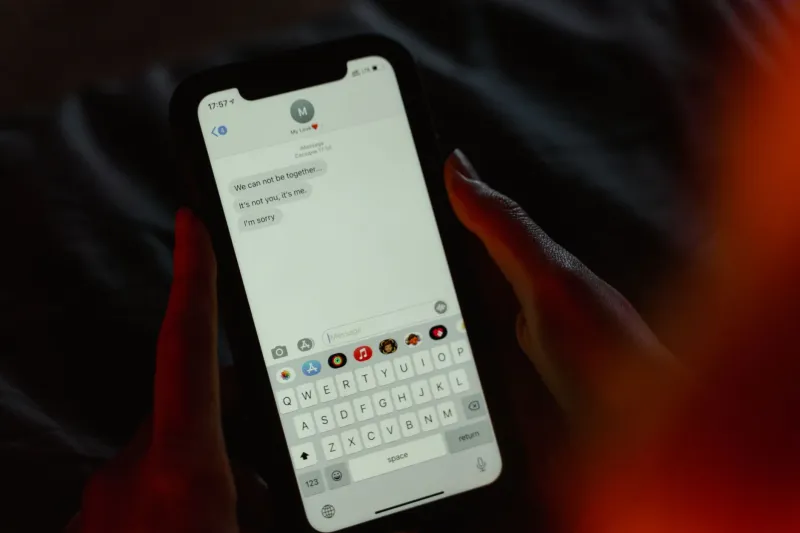
Somewhere between the invention of SMS and the current moment, punctuation stopped being a grammatical tool and became a psychological warfare device. Nobody voted on this. Nobody signed a treaty. One day, a period was just a period — and the next day, receiving "Okay." from your mom meant you had approximately four to six hours before the silent treatment began.
Welcome to the unspoken grammar of modern texting, where a dot can end a friendship, three little dots can simulate a panic attack, and the complete absence of punctuation is somehow the warmest thing anyone can send you.
The Period: Innocent Punctuation or Declaration of War?
Let's start with the villain of this story. The humble period. In every English class you ever sat through, the period was presented as a neutral, helpful little guy — it ends sentences, it signals completion, it keeps your writing from becoming one long unreadable run-on. Nobody warned you that in the texting dimension, it becomes a grenade.
Here's a real-world scenario millions of Americans have lived through:
You text your mom: "Hey, I can't make it to Sunday dinner this week."
She replies: "Okay."
You are now in danger.
Not "Okay!" Not "Okay, no worries honey!" Not even a plain "ok" with the casual lowercase that signals she's moved on with her life. The period transforms that single word into a verdict. It is a judge's gavel. It is the sound of a door closing. Your mom is not okay. Your mom is profoundly, legendarily not okay, and she wants you to know it — through the ancient art of technically not saying anything at all.
The cruel irony is that your mom learned to use that period correctly. By the rules of grammar, she's doing everything right. She's just also emotionally devastating you in the process, and she might not even know it.
The Ellipsis: Three Dots, Infinite Dread
If the period is a cold war, the ellipsis is a horror movie. Those three little dots trailing off into nothing — ... — represent the texting equivalent of someone turning around slowly in a dark hallway. Something is coming. You just don't know what.
From a friend, an ellipsis in response to your plans usually means one of three things:
- They're genuinely thinking of how to phrase something.
- They're mildly annoyed but too polite to say so directly.
- They're catastrophically annoyed and building a case.
The problem is you have absolutely no way to tell which one it is until the follow-up text arrives, and in that window of uncertainty, your brain will helpfully generate every worst-case scenario it can find. Did you say something wrong last Tuesday? Was it the thing about the restaurant? It was definitely the thing about the restaurant.
Consider this exchange:
You: "Hey, I invited Jake to the group hangout, hope that's cool!" Friend: "..."
You have aged seventeen years in the time it took to read that. Jake is clearly not cool. Jake was never cool. You have made a terrible mistake involving Jake, and the ellipsis is the polite way of telling you that without technically telling you anything. The ellipsis is your friend's way of saying I am choosing my words very carefully so I don't end up on a true crime podcast.
The Exclamation Point: America's Most Overworked Punctuation Mark
Here's where things get genuinely absurd. Because the period became weaponized and the ellipsis became ominous, the exclamation point got conscripted into doing the emotional labor that punctuation was never designed to handle.
Now, exclamation points don't signal excitement. They signal basic human warmth. "Sounds good!" doesn't mean someone is thrilled. It means they are a functioning, non-hostile member of society who wants you to know they're not mad. "Thanks!" doesn't mean gratitude — it means "I acknowledge this interaction and I'm not building a case against you."
The exclamation point became the texting equivalent of a smile at a stranger — a social minimum to reassure everyone around you that you're not a threat. Which means when someone drops the exclamation point and goes with "Sounds good." instead, the entire emotional register shifts from pleasant interaction to impending confrontation.
We have created a system where the grammatically correct option reads as hostile and the technically incorrect option reads as friendly. English teachers across the country should be furious. They are probably too busy texting "Noted." to their students to notice.
No Punctuation: The Warm Lawless Wild West
Here's the twist ending nobody saw coming: the most relaxed, friendly, low-stakes texts are the ones with zero punctuation at all.
"yeah sounds good lol" is the most chill sentence in the English language. There is no threat here. Nobody is building a case. The lowercase, the missing apostrophe in what could have been "yeah, sounds good, lol" — all of it signals a complete absence of formal tension. This person is basically sending you a digital hug made of grammatical chaos.
Meanwhile, "Yeah, that sounds good." is a ticking clock. The capitalization. The comma. The period. This person sat down, chose their words, applied correct punctuation, and that level of deliberate effort in a casual text means something. It always means something.
Why Are We Like This?
The honest answer is that texting stripped out every other signal we use to understand tone — no facial expressions, no vocal inflection, no body language — and left us with just words and punctuation. So we started reading punctuation the way we'd read a face, scanning for micro-expressions in the dots and dashes, trying to figure out if we're safe.
And because we all started doing this simultaneously, without coordination, we accidentally invented a brand new language. A language where the rules are completely made up, constantly evolving, and different for every generation. Your grandmother's "I love you, dear." is warm and genuine. Your college roommate's "I love you, dear." is a threat assessment.
The funniest part — and there is a funny part, buried under all the anxiety — is that most of the time, the person sending the text has absolutely no idea any of this is happening. Your mom typed "Okay." and hit send and went back to watching her show. She wasn't thinking about tone or subtext or the psychological demolition she just performed on your afternoon. She just answered your text.
The terror lives entirely in the receiver's head. We built this elaborate, anxiety-producing grammar system and then forgot to tell each other we built it.
So next time you get an "Okay." from someone and your stomach drops — just remember: they might be completely fine. Or they might be furious. There's genuinely no way to know.
Maybe just call them.
Lol just kidding. Nobody's calling anybody. We'll just keep suffering in silence and reading too much into the dots.
...